From a TP53 variant to an evidence-anchored hypothesis in one session.
Enter any variant and read what is actually measured: the Measured binding card searches the public ChEMBL bioactivity archive live for your specific variant, plus same-residue context, and surfaces published Kd, Ki, IC50 and EC50 values with their assay method and original citation. Cohort frequency, functional screens and cited literature sit alongside. The computational shortlist is a transparent physics screen for cavity fit and ligand efficiency, anchored in measured data and published evidence — docking scores are never presented as binding affinities. Every number auditable, every export reproducible.
More than half of human tumours carry a TP53 mutation. Understanding what each variant breaks, and what could reactivate it, is one of oncology's highest-stakes questions.
Oncyra folds the steps a cancer biologist would otherwise chase across many tools, variant entry, receptor selection, mutation-aware modelling, WT overlay, cavity map, live measured-binding lookup against the public ChEMBL archive for your specific variant plus same-residue context, ligand screening against 3,311 approved drugs and a curated rescuer library, per-residue interaction analysis, evidence-linked rescue shortlisting, orthogonal in-cell validation including a live cell physiology simulation, and a reproducible screen export, into a single continuous session across roughly 4,000 TP53 variant profiles.
The problem, the gap, and what Oncyra actually does about it.
TP53 is mutated in over half of human tumours, yet direct reactivators remain rare and mutation-specific. Oncyra collapses the mutation → structure → pocket → ranked ligand loop into a single transparent session across roughly 4,000 TP53 variant profiles and 3,311 approved drugs, and shows its work at every step.
One mutation, one target, years of setup.
Each p53 hotspot (R175H, R248Q, R273H, Y220C, R282W and beyond) has a distinct destabilisation and pocket signature. Standard pipelines rebuild the structural and screening context from scratch per variant.
Pathogenicity scores stop short of a rescue hypothesis.
General pathogenicity scores classify a variant as damaging but do not identify the disrupted structural motif or the ligand class most likely to reactivate it. Oncyra targets that mechanistic gap.
Mutation-aware, mechanistic, and honest.
Mutation-aware candidate model with WT overlay and cavity map, deterministic physics-first screening against 3,311 approved drugs and a curated rescuer library (cavity-fit prefilter, then docking, then ligand-efficiency ranking), curated motif attribution, calibrated uncertainty bands, and DMS overlays, all exported as JSON across roughly 4,000 TP53 variant profiles.
From mutation to rescue candidate
Eleven stages, one continuous workflow, sequenced so a cancer biologist can move from a variant to an evidence-linked candidate without leaving the session.
Variant entry
Enter a TP53 protein change or upload a catalogue covering up to roughly 4,000 variants. The workspace keeps only variants that can be structurally folded and docked, so the rest of the session works on a well-defined set.
Receptor selection
Choose an experimental PDB, upload a private PDB or CIF, or use a mutation-aware candidate model when no experimental structure fits the variant.
Interactive 3D view
The 3D viewer keeps working when optional volume servers are unreachable. Click a residue in the sequence to focus on it in the structure with legible atom, residue, and element labels at any zoom level.
WT overlay and cavity map
Kabsch RMSD, per-residue displacement, and a geometric grid-scan pocket finder (including metal cofactors) surface cavities around the mutation site. Static model. Dynamics-opened cryptic status still needs MD.
Ligand screening, de-novo generation and hand-drawn design
Screening runs in three lanes with separate session records. Screen Library: Stage 1 ranks the whole library (381 curated rescuers plus, optionally, 3,311 approved drugs) by physicochemical cavity fit using Chem Toolkit descriptors; Stage 2 docks only the best-fitting candidate with a Lennard-Jones plus Coulomb plus H-bond force field. Generate De Novo: a fragment-masked generator proposes pocket-sized structures that are filtered to the cavity's heavy-atom window and docked on the same terms. Design & Dock: you draw a molecule yourself in the built-in structure editor; it is parsed, sanitised and size-checked by the Chem Toolkit, saved per variant in your own browser, and docked through the identical pipeline - tagged 'manual design - no literature evidence' and never mixed into the screening or de-novo counters. Each lane runs one compound per click, with explicit add-more increments of 1, 5, 10, 25, or 50. Receptor can be a catalogue PDB, a candidate model, or an uploaded structure.
Top-N docking and comparison
Docked hits are ranked by ligand efficiency (kcal/mol per heavy atom) so large scaffolds do not win on size alone, then reloaded into the 3D viewer. The scorer is an empirical Lennard-Jones plus Coulomb plus H-bond fit with a distance-dependent dielectric and a pruned conformational search: no explicit solvation, no entropy term, no induced fit. It orders cavity fit and does not price desolvation, so ligand efficiency is the guard against size bias rather than a free-energy claim. Every pose passes a structure-validation gate (parseable MOL block, resolvable elements, valid bond orders, genuine 3D spread, no NaNs) before it is drawn, and the viewer shows one compound at a time by default with a configurable in-scene cap. A side-by-side dialog compares the docked set with Chem Toolkit descriptors on one screen. Literature evidence is shown as a label, not a filter.
Per-pose diligence
Every dock is followed by a geometric ligand-residue interaction scan (H-bond, hydrophobic) and a Pose Checks-style geometric sanity check (clashes, bond lengths, containment, compactness, element sanity).
Motif attribution
For curated hotspot variants, static SAE-derived profiles map the mutation to disrupted structural motifs (DBD hydrophobic core, L2/L3 zinc coordination, DNA-contact loop) alongside per-residue ΔΔG.
Experimental overlays
Deep-mutational-scanning data, the Sánchez-Rivera Lab prime editing sensor screen, and a live ChEMBL measured-binding lookup are joined per variant so published in-cell fitness and real assay affinities sit next to the prediction.
Rescue-vs-inhibit reading
Every candidate is scored as rescuer versus inhibitor with transparent features and a calibrated uncertainty band. Fitting the mutant cleft in silico is not thermal stabilisation: reactivation requires raising the melting temperature of the DNA-binding domain, which no docking score measures, so a thermal-shift or cellular reactivation assay remains the confirming experiment. The positive training set for rescuers is also small - only a handful of published reactivators exist - so precision figures on the validation panel are fragile and are reported with that caveat. RescueBench splits its evaluation into the Rescue task (curated compound-mediated reactivation triples - what the scorer is designed for) and the LoF-tolerance task (MaveDB Nutlin/Etoposide fitness - variant tolerance, not rescue), and reports AUROC separately for hotspots vs. rare mutations plus a leave-one-mutation-out row that isolates structural inference from memorized literature. Every per-mutation Rescue Brief exposes a deterministic shortlist gate - panel-active (≥0.40), matched-class, or broad-class+lit - and RescueBench reports Precision@10, Precision@25 and Recall@shortlist on that same gate so precision and recall are directly comparable to the UI.
Structured screen export
The full visible screen exports as a single organised JSON snapshot: mutation metadata, active structure with provenance, every card value, tables, links, docked poses, per-pose diligence, MedChem results (SA score, ADMET, lead-optimisation output) and citations. Fields that have not been computed in this session are null, never fabricated.
The platform in action
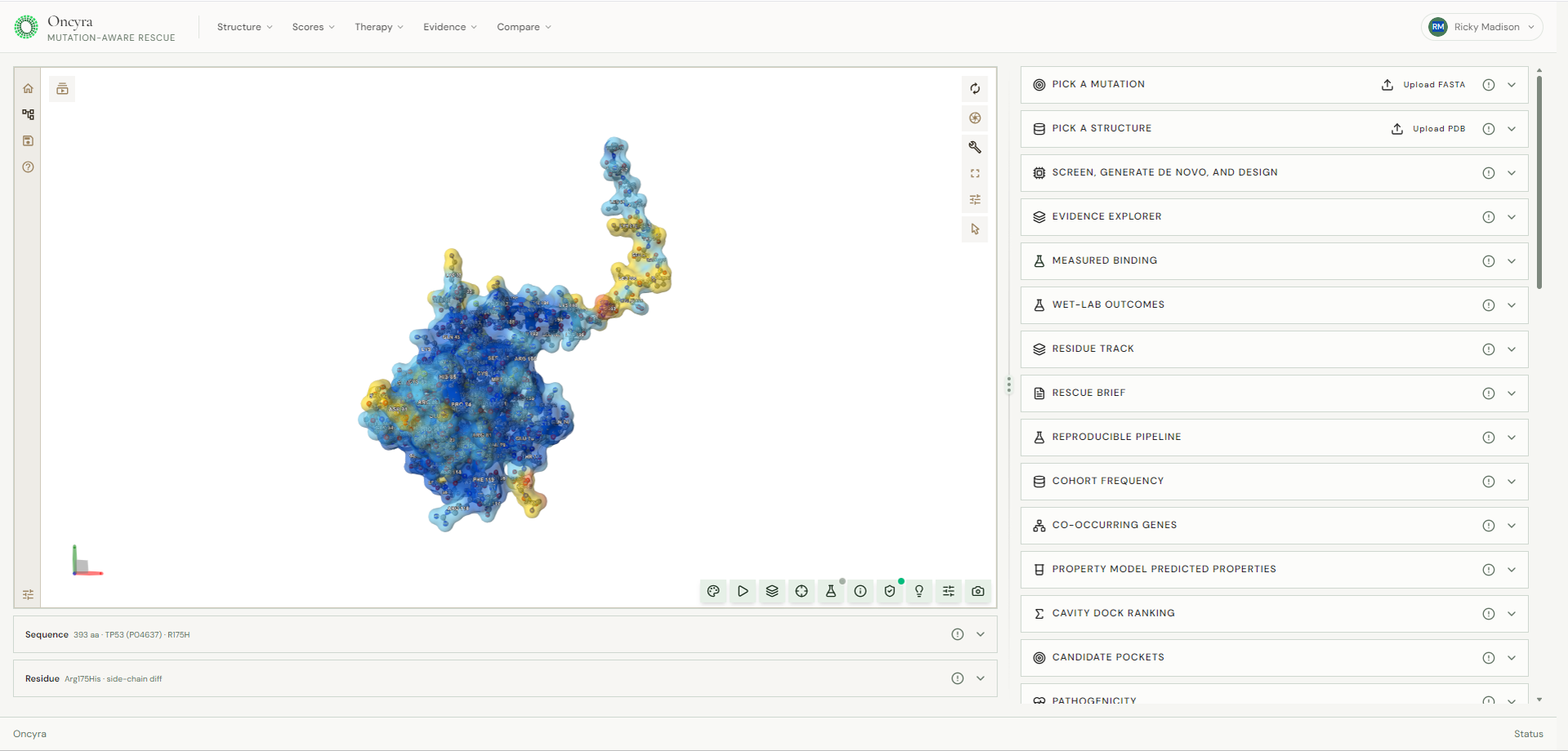
Continuous workflow
Variant entry, receptor choice, modelling, docking, pose diligence and shortlisting all live on one screen, so context is never lost between steps.
Interactive 3D residue view
Click a residue in the sequence and the viewer focuses on it with legible atom, residue and element labels at any zoom.
In-browser chemical space
ECFP4 fingerprints computed in a worker and cached locally: Tanimoto search, scaffold-hop view, descriptors with PAINS/Brenk alerts, PCA map and CSV export. Descriptor arithmetic only.
Side-by-side ligand comparison
Compare the docked shortlist in one dialog: 2D structures with MW, cLogP, HBD/HBA, TPSA, rotatable bonds and Ro5 violations.
Ligand ↔ residue interactions
Every dock is followed by a deterministic geometric scan for hydrogen bonds and hydrophobic contacts, residue by residue.
Pose sanity checks
Pose Checks-style geometry (clashes, bond lengths, containment, compactness, element sanity) runs on every pose alongside its score.
Modular generative pipeline
Generation and evaluation stay separate. Pocket volume sets a heavy-atom budget for the generator; returned SMILES are re-parsed, re-filtered, embedded and docked by the same local physics.
Physics-first rescue shortlist
The table ranks the library by cavity fit before anything is docked, so novel hits can surface on geometry alone rather than only known names.
Approved-drug repositioning
3,311 approved drugs can be swept against any TP53 pocket in-session: ranked by cavity fit, then the best-fitting batch is docked. A sweep this size under a simplified scorer produces predictable false positives - highly charged or flat molecules that fit in vacuum but fail on permeability or plasma-protein binding - so treat it as a triage shortlist, not a repositioning claim.
Live measured binding
The measured-binding card queries public bioactivity archives live for published Kd, Ki, IC50 and EC50 with assay and citation. Nothing is imputed.
Disease and homology context
Live TP53 disease associations and structurally similar PDB entries sit beside the loaded receptor, with a secondary source for bioactivity.
Medicinal chemistry suite
Paste any hit SMILES to get a synthetic-accessibility score, an extended rule-based ADMET profile (solubility, GI absorption, hERG risk, CYP, P-gp), bioisosteric analogues and a closed lead-optimisation loop ranked on SA, ADMET quality and scaffold similarity.
Retrosynthesis hints
The docked ligand is scanned for named-reaction retrons and every plausible disconnection is listed. Single-step only, not a route search.
NCI GDC cohort context
Live per-project case counts, cohort frequencies and top co-mutated genes for the selected variant. Overlay only — rankings are unchanged.
Mutation evidence explorer
Pocket class, ΔΔG, DMS and sensor readouts, cohort frequency and curated literature gathered into one collapsible card next to the prediction.
Residue overlay track
A 1D sequence track aligns per-residue DMS and prime-editing sensor values, aggregated per codon so hotspot signal is not diluted.
Rescue-vs-inhibit scatter
pRescue against pInhibit for the docked shortlist, separating rescuers, inhibitors and ambiguous compounds before any ranking call.
Live cell physiology (illustrative model)
An in-browser ODE-driven p53/MDM2/p21/Bax network uses Human Protein Atlas cell-line consensus nTPM for the selected context plus literature-derived protein and turnover anchors. It is one generic rescue mechanism applied qualitatively across the catalogue, not variant-specific pathway rewiring: apply a docked hit, vary dose, watch the pathway respond, and export the run as a video — not a clinical prediction.
Europe PMC evidence backbone
Variant, receptor, pocket and every ligand are checked live against the full-text literature index, returning a per-step verdict with the papers behind it.
Batch mode and run history
Queue several variants and re-open any past session: docks, generated structures and designs persist per variant in your browser.
Re-measurable benchmark ledger
Enrichment, calibration, site labelling, cavity detection and pose accuracy can each be re-measured in your own browser, recorded next to the published value.
Manual design lane
Draw a molecule in the built-in editor, save it per variant and dock it through the identical pipeline. Manual designs never enter benchmark counters.
A–E grade on every hit
One letter folds pose quality, site relevance, geometry, efficiency and published evidence into a readable verdict; click it for the full weighted breakdown.
Literature-anchored ranking
Published evidence for a compound against the exact variant or its mechanism class is scored and blended with the pose result, itemised and traceable.
De-novo protein binders
Generate a mini-protein backbone for the mutant pocket, design a sequence at your chosen length and view it beside the receptor, with a foldability pre-check.
Honest small-screen statistics
Runs of three to seven compounds report enrichment with a resampled 95% interval; an interval crossing 1x plainly says the ordering is not yet distinguishable from chance.
On-demand stability prediction
An independent published ΔΔG predictor can be called for any single substitution. Opt-in, measured values win, and an unreachable service is reported as such.
Cavity detection and receptor QC
Pockets are found by an in-browser P2Rank port with a geometric fallback, cached locally; a completeness gate flags missing atoms or chain breaks.
Consensus and ensemble docking
Multiple receptor conformations and scoring passes are compared, agreement is reported and rank-fusion combines them, so setup-specific wins are visible. Each predicted structure is now folded against a real ColabFold multiple-sequence alignment, and the alignment depth is shown on the consensus card so you can tell an evolutionarily-informed fold from a single-sequence guess.
Suggest the next experiment
For the current shortlist the lab proposes the assay, construct and control that would best discriminate the hypothesis, with the expected outcome.
Batch upload from spreadsheets
Drop a CSV, TSV or Excel panel of variants and each one is queued through the identical pipeline, with results written to run history.
AI/ML data behind the app
Models use public, citable data only: ~374k pose-RMSD measurements, complex-with-affinity records across 8 benchmarks, TP53 deep-mutational-scanning and prime-editing sensor panels, curated ΔΔG sets, ChEMBL bioactivities and Human Protein Atlas cell-line consensus RNA. Generative models propose structures only — every score comes from local physics, and no held-out benchmark compound is used for fitting.
Reproducible screen export
One click exports the screen as organised JSON, or a full bundle with report, CSV tables, figures and structure files. Content-hashed; uncomputed fields stay null.
Open provenance and audit trail
Every screen records its inputs, scorer version and the exact public sources behind each number, so any result can be retraced and defended end to end.
Powered by measured analogues, not a black box
Docking scores are never converted into an affinity. The only affinity value shown beside a candidate is read across from the nearest measured analogues in a 4,500-compound set of published affinities (HiQBind, BindingMOAD, GatorAffinity p53 records), as a similarity-weighted mean over the three closest molecules above an ECFP4 Tanimoto cutoff, and it is labelled as read-across wherever it appears. On held-out validation the close-analogue tier reaches mean absolute error 1.14 pKd with 80% within ±1.80 pKd, and every value carries an honest conformal ±band. A ligand-only neural predictor was benchmarked on the same held-out set and failed it (Pearson r = -0.23), so it is not used for the reported column.
4,500 affinities
Read-across draws nearest neighbours from published measured affinities (HiQBind, BindingMOAD, GatorAffinity p53 records), not from a model's training set.
MAE ≈ 1.14 pKd
Held-out validation on 800 measured complexes. 80% within ±1.80 pKd at the close-analogue tier (Tanimoto ≥ 0.5, 52% coverage). For the remaining ~48% there is no close measured analogue: those rows show no affinity value and fall back to physics-only ordering. Honest conformal ±bands, not an extrapolation.
No upload, no queue
The ECFP4 similarity search and read-across run client-side — every screened or generated molecule is scored straight from its SMILES string, with nothing sent to a server.
Real numbers, cited sources, one continuous workflow.
Total experimental and computational measurements across 8 public benchmarks (1,300,000+ unique complex-with-affinity records + 374,518 pose-RMSD measurements; per-source counts on /rescuebench; each run uses only the subset with a resolvable structure/ligand pair)
Protein-ligand complexes in the pose-quality set (BindingNet High MCS RMSD); median heavy-atom RMSD 0.77 Å, 86.7% below 2 Å; operative denominator is the resolvable subset per comparison
Retrospective pathogenicity concordance on the 10-variant primary validation set (curated selection; all 10 variants predicted pathogenic)
Rescue-ligand classification F1 on the 10-variant primary validation set (PASS vs non-PASS; 6 TP, 2 FP, 2 TN, 0 FN)
Retrospective pathogenicity concordance on the 51-variant curated panel (47/51 variants correctly classified; selected validation panel, not a random sample)
Approved drugs (ChEMBL max_phase 4) available for in-browser repositioning docks against any variant
TP53 variants searched live for measured binding data in ChEMBL; catalogue total is ~4,000, while the operative subset is the variants with a resolvable query and returned record; most have no published affinity, reported honestly
Curated TP53, MDM2, and MDM4 rescue ligands sourced from DGIdb, ChEMBL, and PubChem
Full-text life-science articles indexed in Europe PMC, queried live to anchor every pipeline recommendation in published evidence rather than opaque scoring
Reachable TP53 DBD missense variants (4,137 missense in the catalogue; the dockable subset used for structural inference)
Deterministic physics core
Structure viewing, ligand geometry, docking, and scoring run through a transparent Lennard-Jones plus Coulomb plus H-bond force field with simulated annealing. No opaque model file, no hidden calibration.
Prediction, on demand
When a mutation has no suitable experimental structure, a mutation-aware model is generated and streamed back to the viewer across roughly 4,000 reachable TP53 variant profiles. The predictor is fed a real ColabFold multiple-sequence alignment so it sees evolutionary covariation, and the alignment depth is reported beside every predicted fold; if the alignment search is unavailable it falls back to the single-sequence alignment transparently.
Provenance you can filter
Every card carries a provenance tag - measured, measured-modelled or derived - and a global toggle can withhold everything that is not a wet-lab measurement. Dataset row counts, molecule coverage and validation checks are published on the data-quality page.
What the workspace helps a p53 biologist do
A single screen carries a p53 variant from selection to a scored, evidence-linked shortlist. The per-mutation view sits next to experimental data and citations, and every visible result is exportable as a single reproducible snapshot.
- Mutation-aware candidate structures when no experimental PDB fits the variant, across roughly 4,000 reachable TP53 variant profiles, each folded against a real ColabFold multiple-sequence alignment with the depth reported on screen
- Live measured binding lookup: the Measured binding card queries ChEMBL for the exact variant plus same-residue context, normalises units to nM, and links to the original assay record
- Interactive residue focus: click any sequence position to zoom the 3D viewer with legible atom, residue, and element labels at any scale
- Two-stage screening of curated rescuers plus 3,311 approved drugs (ChEMBL max_phase 4): Stage 1 cavity-fit prefilter, Stage 2 in-browser physics docking, ligand-efficiency ranking, one compound per run with 1/5/10/25/50 add-more increments
- De-novo lane: pocket-sized structures proposed from a fragment/mask seed, filtered to the cavity heavy-atom window, then docked and ranked on the same local physics terms as the curated library; unsynthesised computational proposals, labelled as such
- Chemistry-accurate 3D rendering of every pose: CPK element colours and van der Waals radii, single/double/triple/aromatic bond geometry, wedge and dash stereo cues, element letters, and a ligand-versus-protein scale control, with one compound in the scene by default
- Per-pose ligand-residue interaction map, structure-validation gate before render, and Pose Checks-style geometric sanity checks
- Chemical-space workbench: ECFP4 Tanimoto similarity search and descriptor scaffold-hop over the fingerprint index built in a background worker and cached in IndexedDB
- Exact Chem Toolkit descriptors with PAINS/Brenk structural alerts, a documented 0-100 developability triage index, high-confidence filtering, a 2D PCA map, browser-local notes, and CSV export of the filtered or selected compound set
- Side-by-side comparison of the docked shortlist with Chem Toolkit descriptors in one dialog
- Rescue-vs-inhibit reading with calibrated probability, ensemble spread, and confidence band
- Live cell physiology: an in-browser ODE-driven p53/MDM2/p21/Bax network on real protein half-lives and transcript levels, with a stochastic 2D cell that responds to ligand dose, binding and downstream rescue — exportable as video
- Curated motif attribution and per-residue ΔΔG heuristic for the p53 hotspot variants
- Deep-mutational-scanning overlay on the same residue view as the prediction
- Prime editing sensor evidence: 1,227 variants with in-cell MAGeCK LFC across timepoints and Nutlin-3 selection
- Live disease and homology context with a secondary bioactivity source so upstream outages do not stall the session
- Provenance toggle across every table and plot: measured-only mode withholds modelled and score-derived rows, and combined mode keeps them as a separate, never-merged series
- Dataset quality page: per-file row counts, molecule and structure-identifier coverage, affinity-unit normalisation and pass/fail validation checks for every shipped dataset
- Docking visualisation panel: pose inputs, residue-numbering offsets, ligand provenance, and an overlay measuring centroid offset and per-atom distance against every crystal ligand in the receptor file
- Structured JSON export of the full visible screen: cards, tables, links, scores, and citations, with uncomputed fields left null
Look up a variant. Get catalogue-backed records.
Variant lookups run as deterministic search over the curated mutation catalogue, so every answer maps back to a catalogue row with its citation - no generated prose, no runtime model.
>Curated rescue compounds for R248Q
>TP53 hotspots ranked by dockable-pocket score
>R175H versus R273H mechanism records
Frequently asked, honestly answered.
What it does, how confident it is, and where it stops. Ten chapters, plain answers. Pick one to begin.
Open a variant and work through it end-to-end.
Sign in with your credentials. Accounts are provisioned by the Oncyra team.